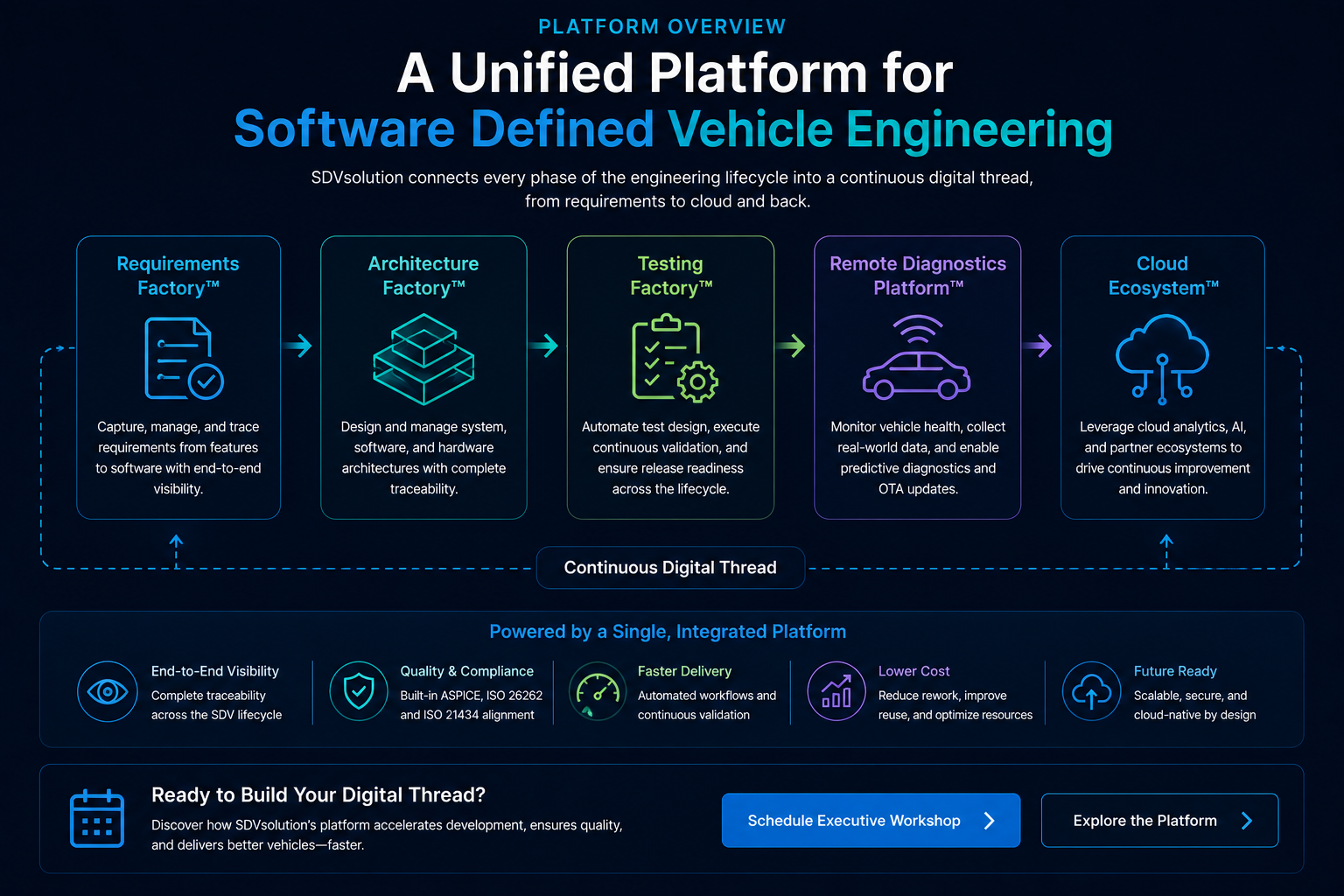
From Vehicle Features to Production Software
Requirements → Architecture → Software → Integration → Validation → OTA → Fleet Intelligence
SDVsolution transforms OEM features into validated software-defined vehicle capabilities through AI-driven Systems Engineering, Integration, and Verification.
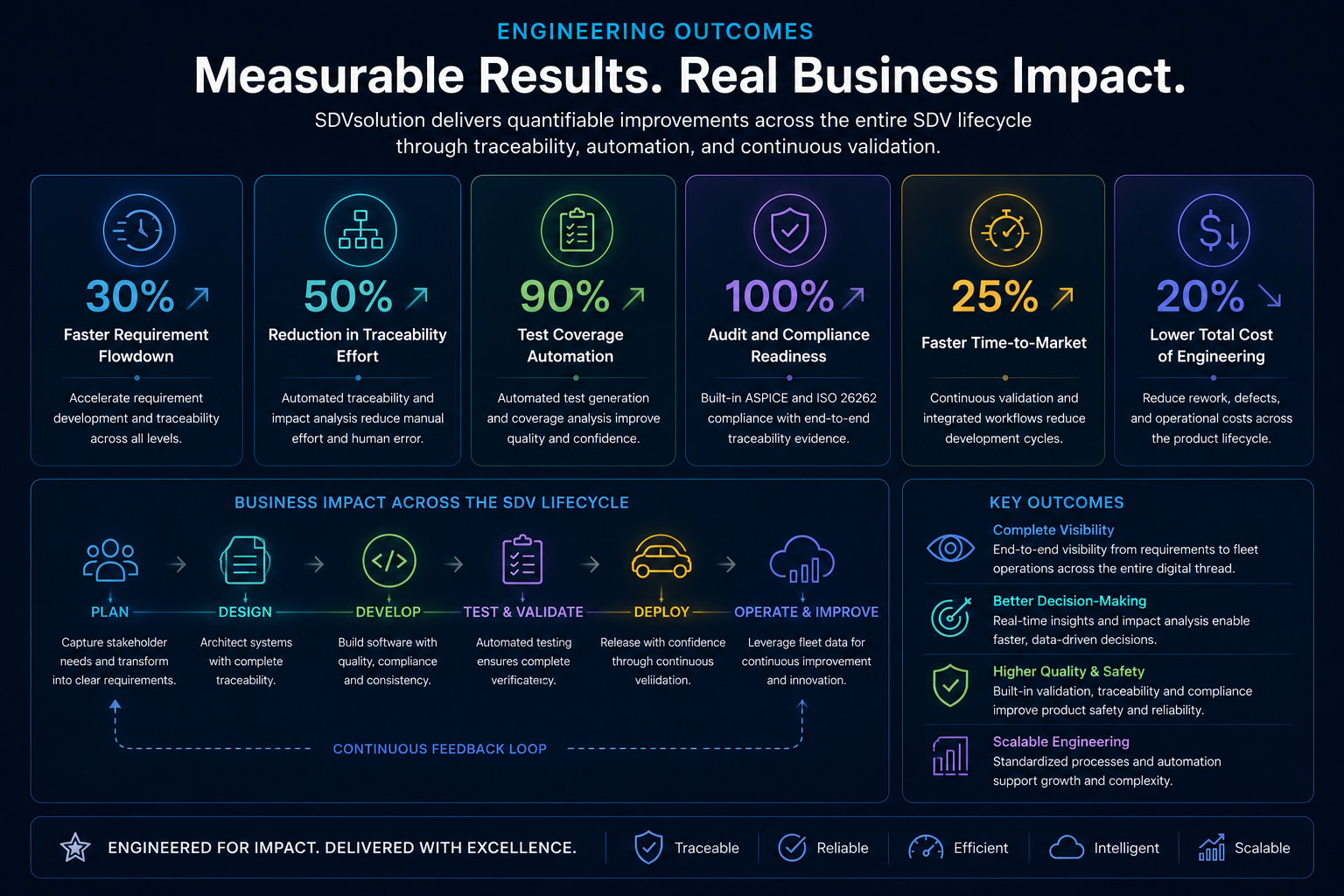
ENGINEERING OUTCOMES
Deliver Measurable Results
Leverage AI-powered workflows to improve engineering efficiency.
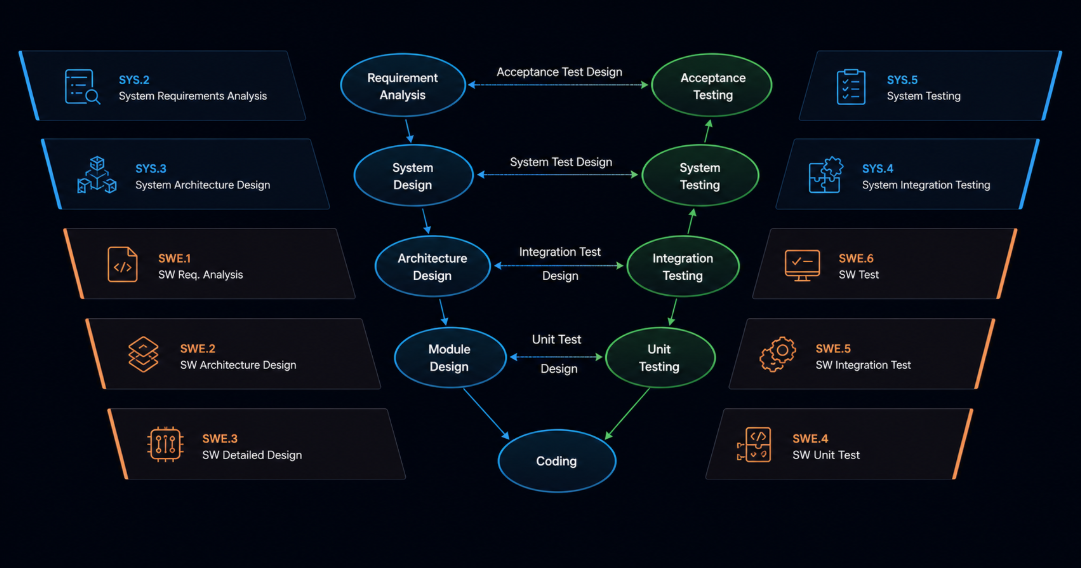
System Engineering & Integration at SDVsolution connects vehicle‑level intent to software implementation and verification. We use a disciplined V‑Model approach spanning system requirements, architecture, software design, and multi‑level testing to ensure that every feature is traceable, testable, and integrable across the SDV stack.
THE CHALLENGE
Why Traditional Development Breaks Down
Modern vehicles contain:
100+ ECUs
Millions of lines of software
Cloud-connected services
OTA update capability
Complex safety and cybersecurity requirements
Without end-to-end traceability, engineering organizations face:
❌ Requirement gaps
❌ Verification challenges
❌ ASPICE compliance risks
❌ Delayed vehicle programs
❌ Increased development costs
WHAT WE DO
System Requirements Analysis (SYS.2): Translate customer, regulatory, and business needs into clear, testable system requirements.
System Architecture Design (SYS.3): Define domain and ECU responsibilities, interfaces, and data flows across powertrain, ADAS, body, infotainment, and cloud.
Software Requirements & Architecture (SWE.1–SWE.3): Decompose system behavior into software requirements, architecture, and detailed design for each component and service.
End‑to‑End Integration & Test (SWE.4–SWE.6 & SYS.4–SYS.5): Plan and execute unit, integration, system, and acceptance testing aligned to the V‑Model.
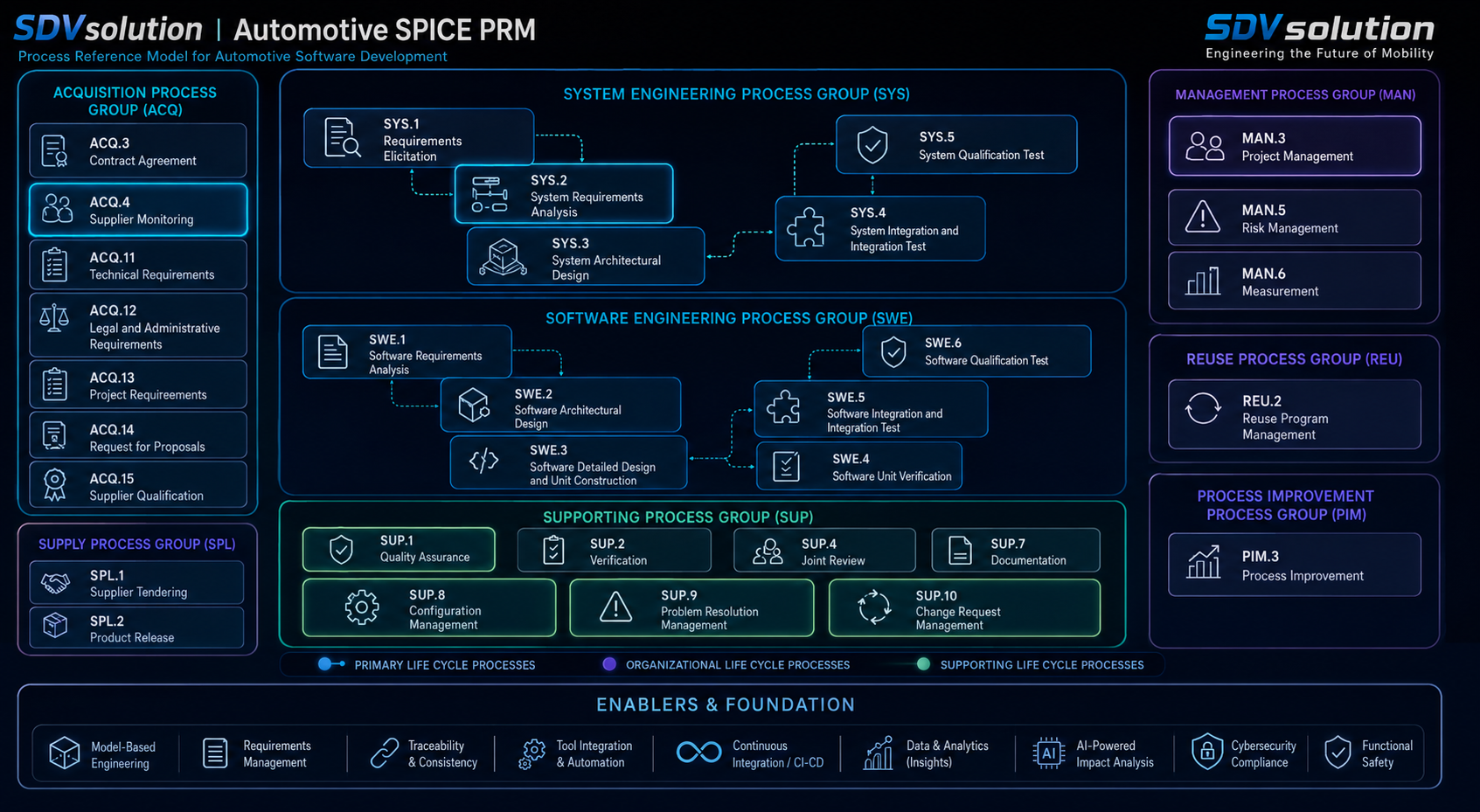
Our approach mapped to the V‑Model
Requirement → Architecture → Software → Test Case → Test Result → OTA Release
Left side – From intent to design
Requirement Analysis
SYS.2 System Requirements Analysis
SWE.1 SW Requirements Analysis
Capture feature behavior, constraints, and non‑functional requirements (safety, security, performance).
System & Architecture Design
SYS.3 System Architecture Design
SWE.2 SW Architecture Design
Define domains, ECUs, services, interfaces, and communication patterns (CAN, Ethernet, cloud).
Module / Detailed Design
SWE.3 SW Detailed Design
Specify components, APIs, state machines, and data models ready for implementation.
Coding
Implementation of software components, services, and integration logic according to the detailed design.
Right side – From design to verified system
Acceptance Testing
Validate against customer and regulatory expectations; support launch readiness and sign‑off.
System Testing
SWE.6 SW Test
SYS.5 System Testing
Confirm that the integrated system meets system requirements and non‑functional targets.
Integration Testing
SWE.5 SW Integration Test
SYS.4 System Integration Testing
Validate interactions between ECUs, services, and domains.
Unit Testing
SWE.4 SW Unit Test
Verify modules and components against detailed design.
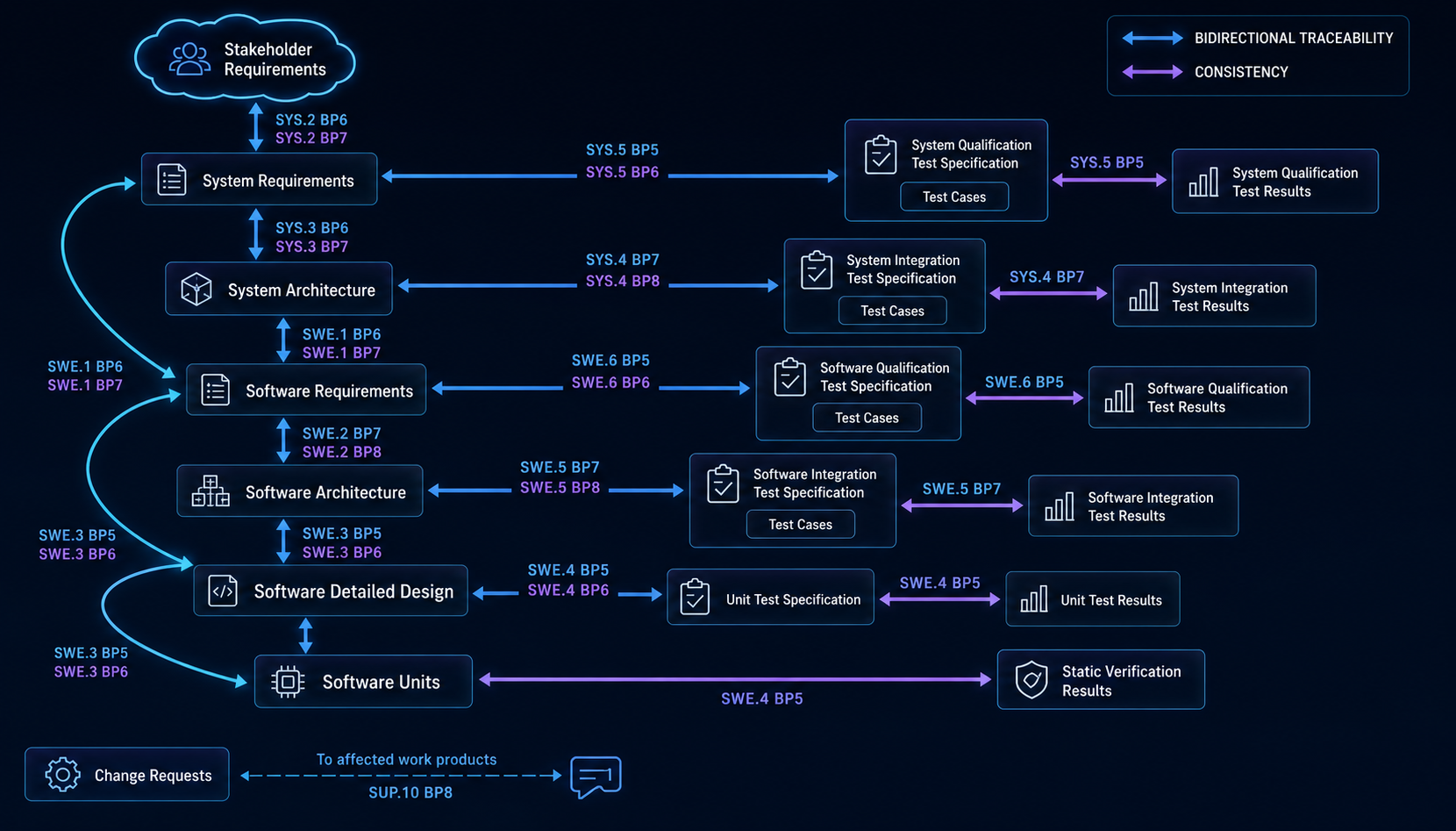
DIGITAL THREAD
End-to-End Engineering Traceability
Every requirement remains connected from concept through validation, enabling complete engineering visibility and change impact analysis.
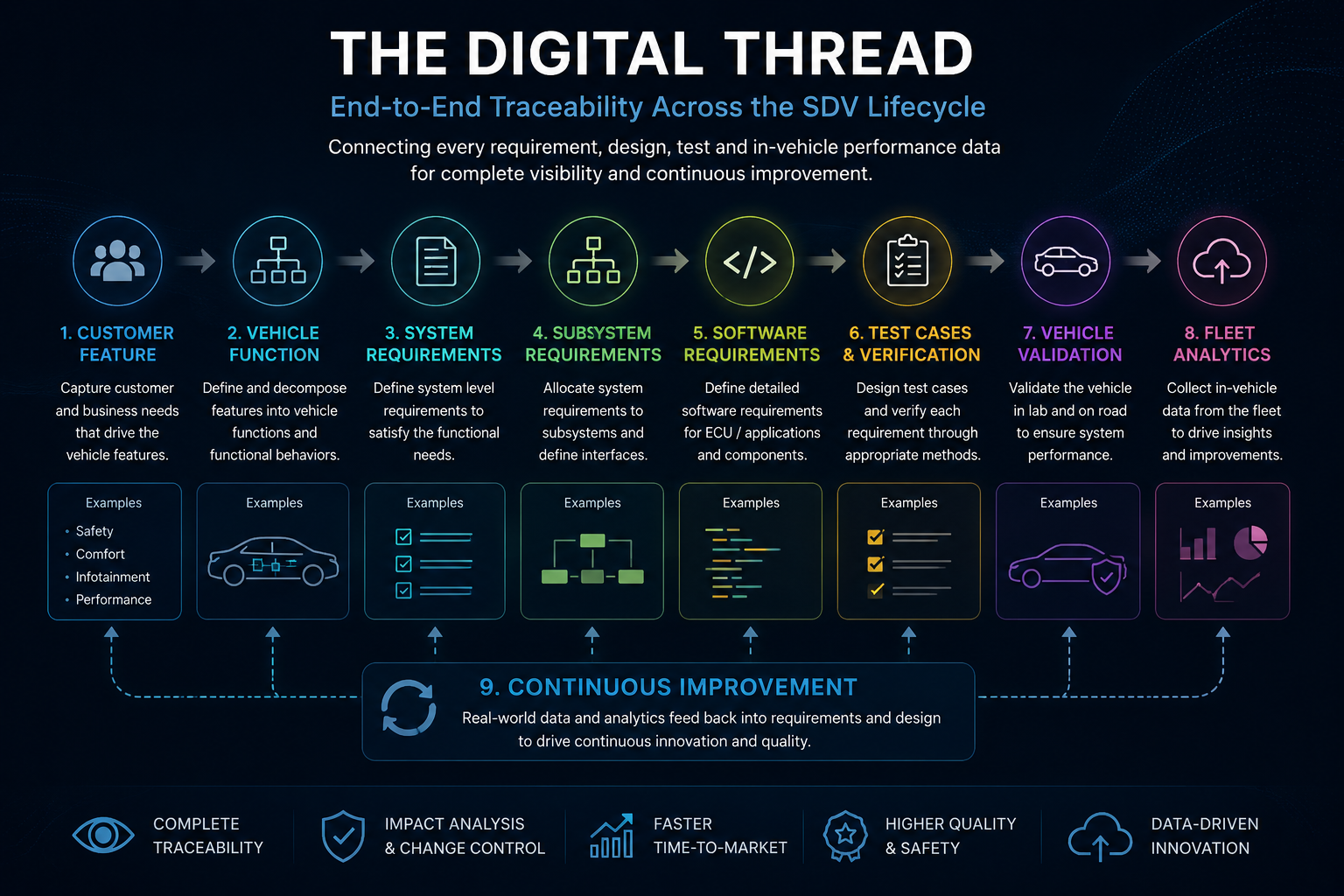
REQUIREMENTS FACTORY
Engineering Traceability at Scale
Requirements Factory transforms vehicle features into verified software requirements while maintaining complete traceability throughout development.
Capability
Feature Management - Capture customer and business needs
System Requirements - Define vehicle-level functionality
Subsystem Requirements - Allocate requirements across domains
Software Requirements - Support SDV software development
Traceability - End-to-end requirement linkage
Compliance - ASPICE and ISO 26262 alignment
BENEFITS
Improved requirement quality
Reduced engineering rework
Full traceability
Faster program execution
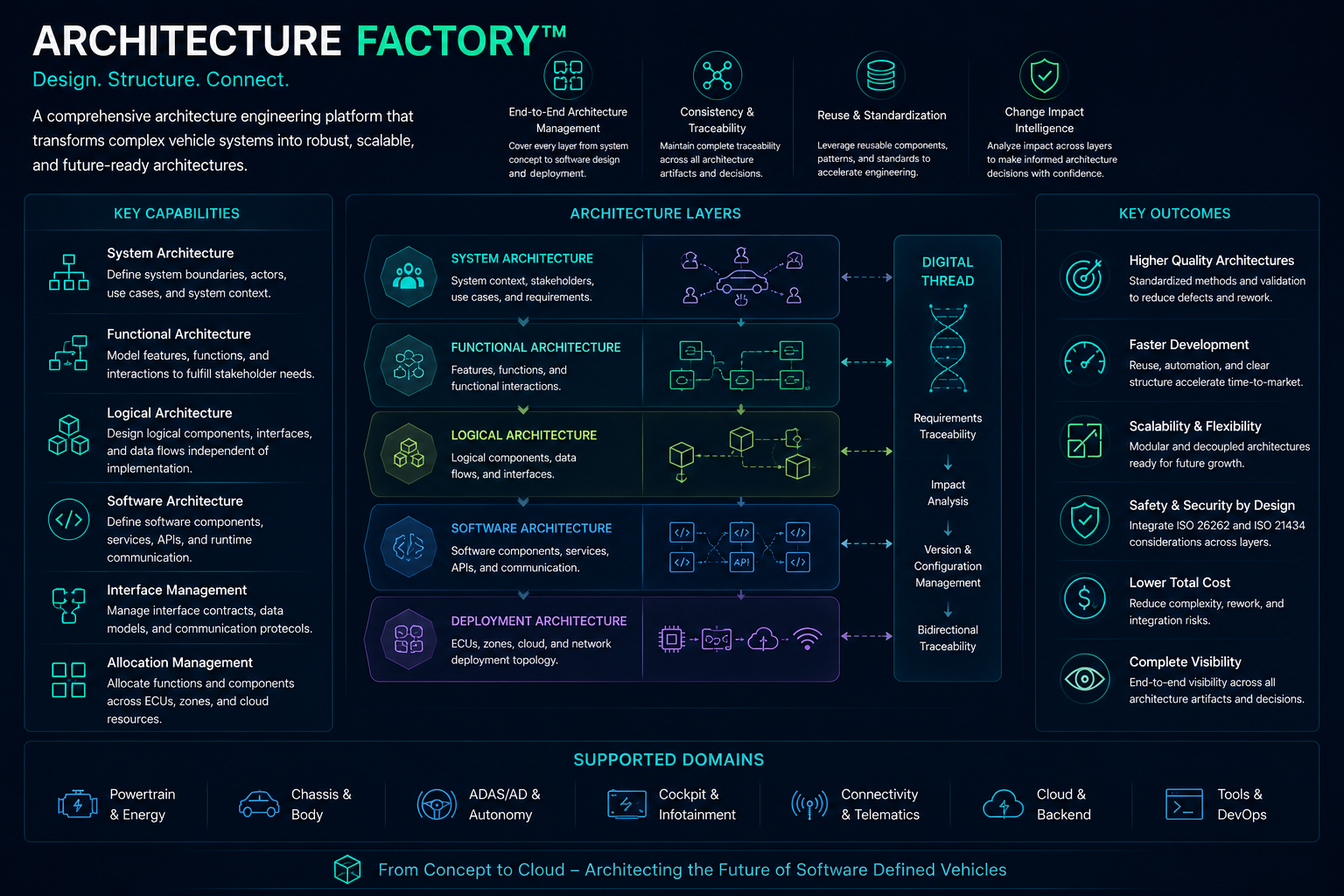
ARCHITECTURE FACTORY
Built for Automotive Compliance
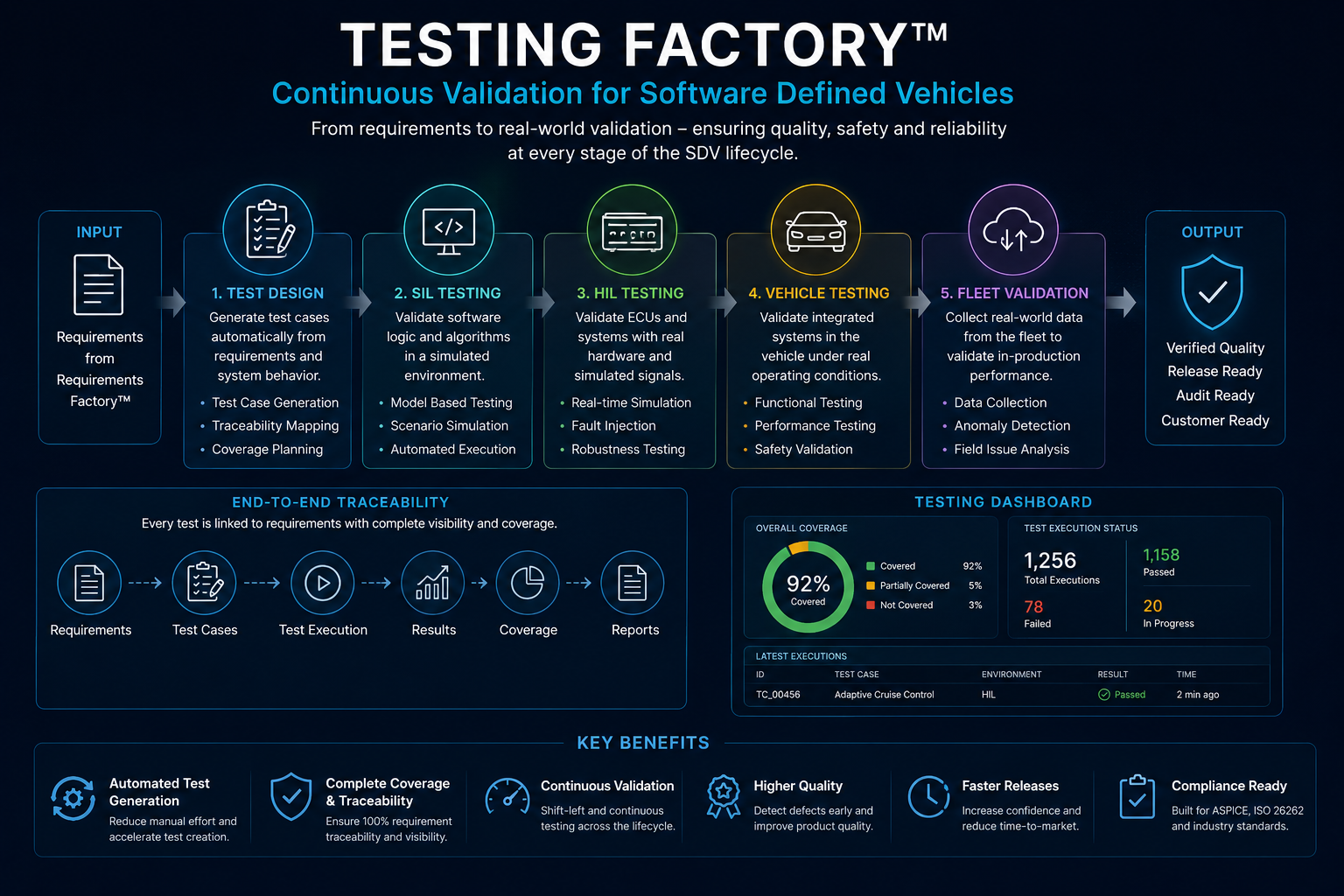
TESTING FACTORY
Continuous Validation for SDVs
Testing Factory provides automated validation workflows that ensure every requirement is verified before deployment.
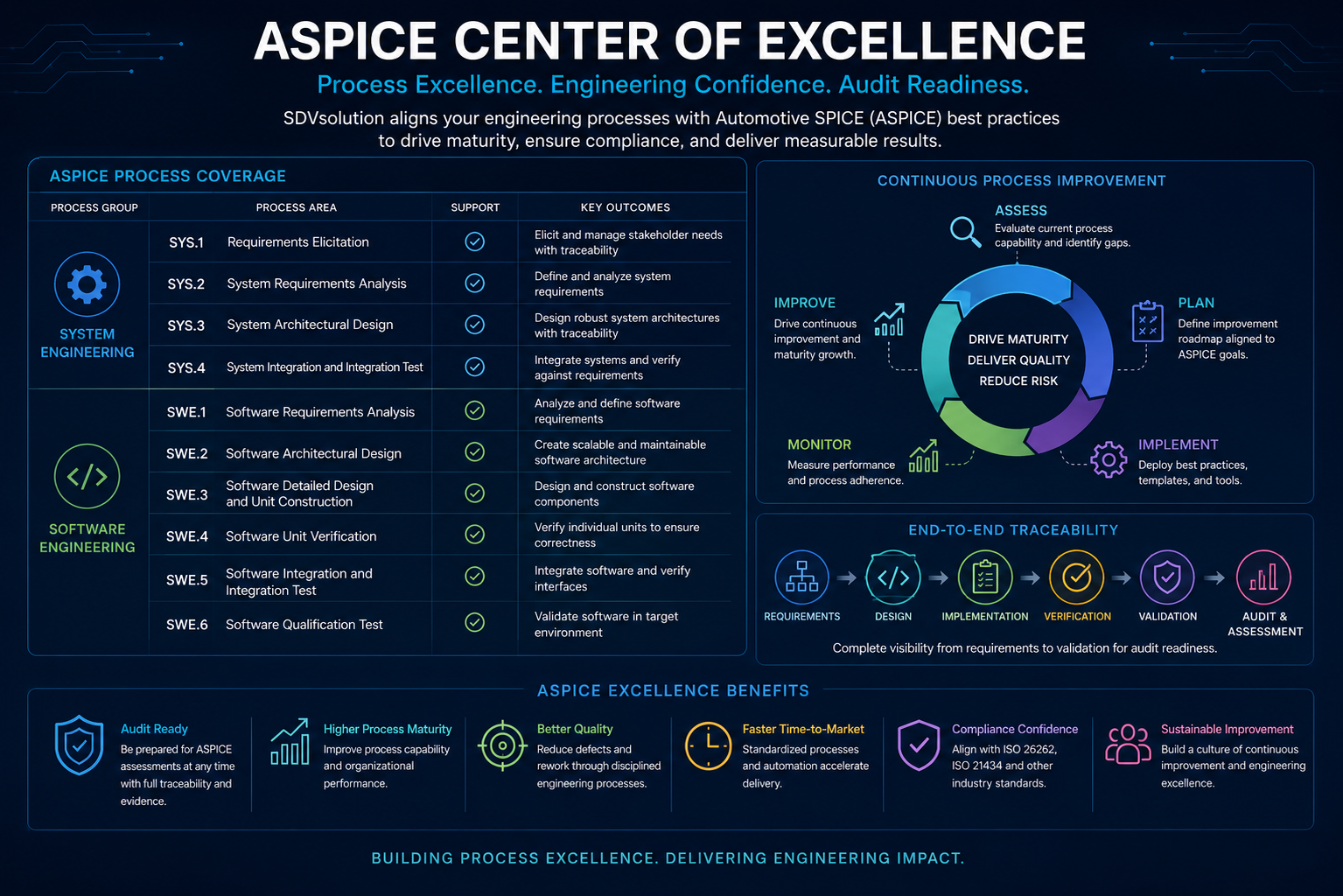
ASPICE CENTER OF EXCELLENCE
Built for Automotive Compliance
SDVsolution aligns engineering workflows with Automotive SPICE best practices.
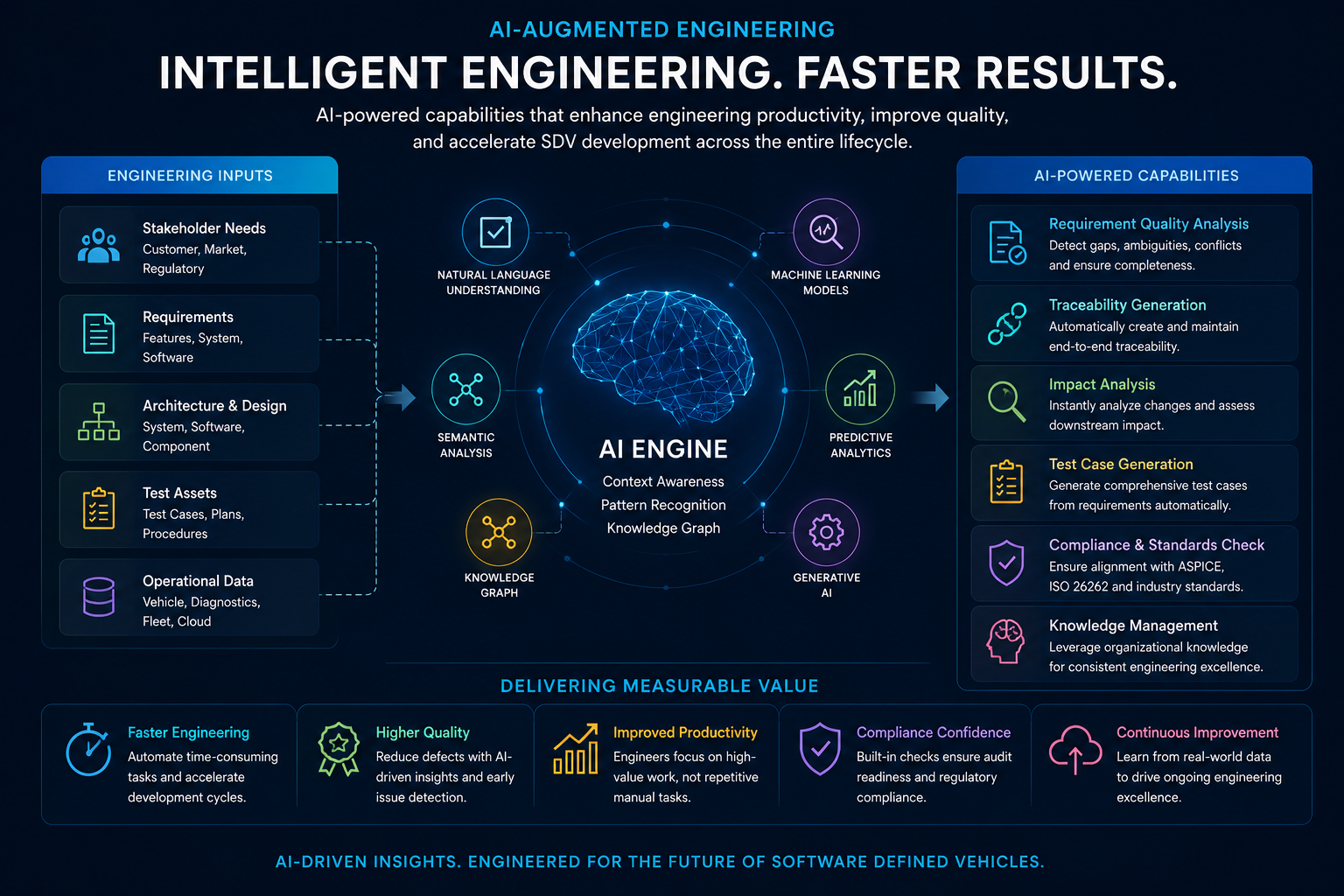
AI-AUGMENTED ENGINEERING
Accelerate Engineering Productivity
Leverage AI-powered workflows to improve engineering efficiency.
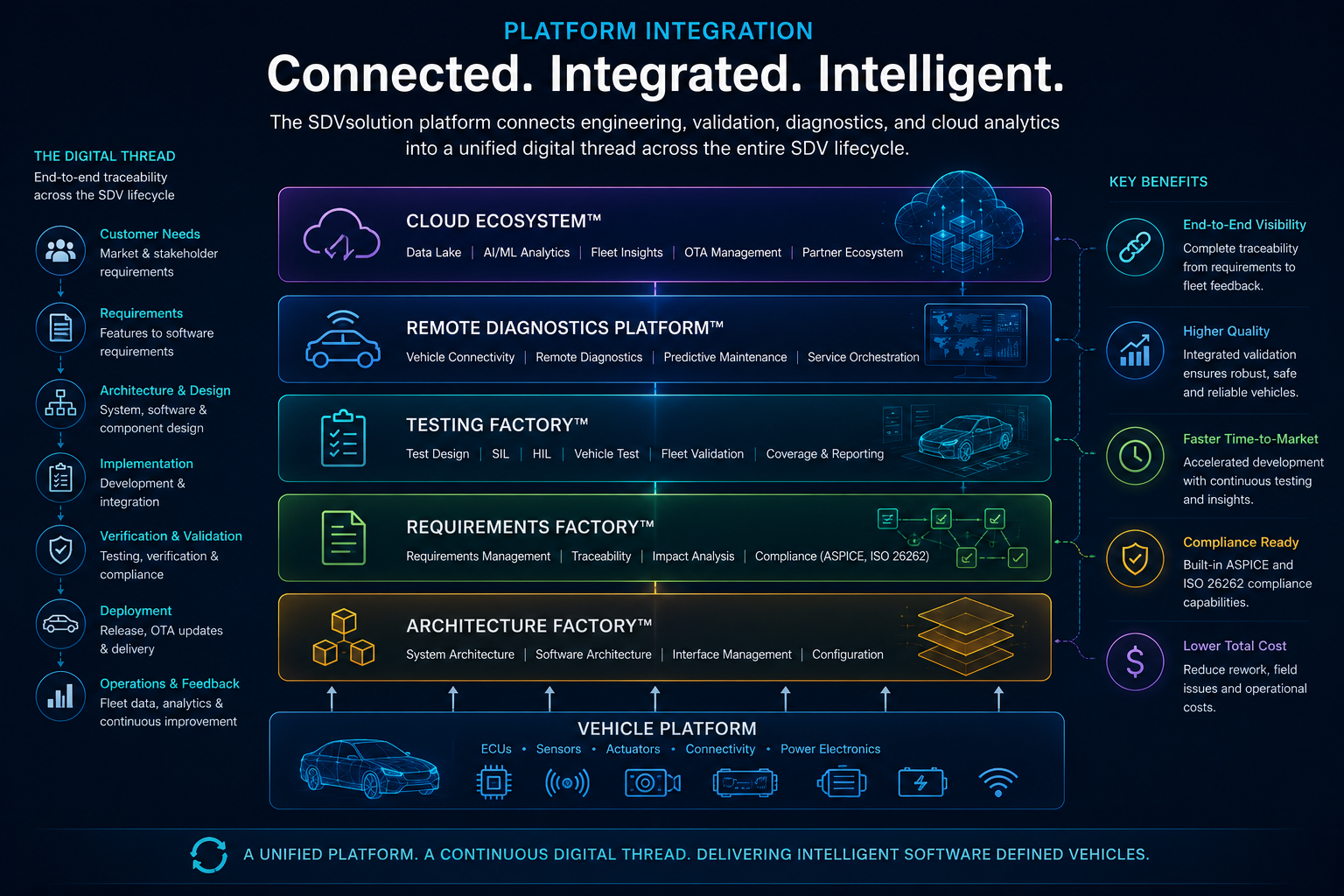
PLATFORM INTEGRATION
Connected Across the SDV Lifecycle
SDVsolution connects vehicle engineering, validation, diagnostics, and cloud analytics into a single software-defined vehicle ecosystem.